This isn't speculation.
This isn't a conspiracy theory.
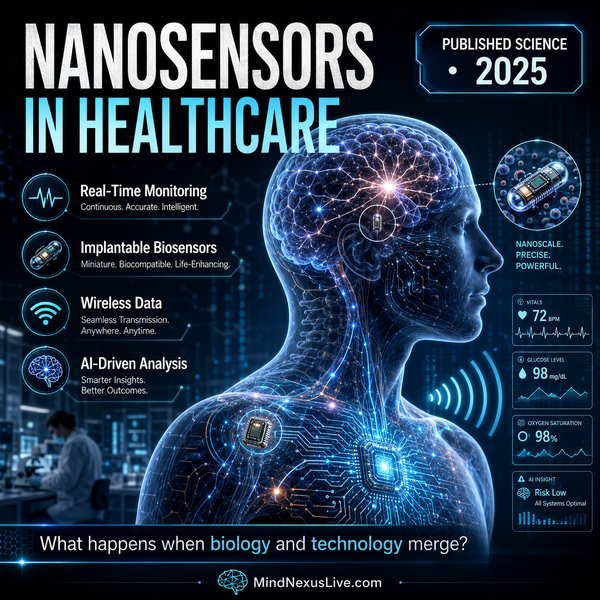
This is published science explaining what researchers are building with nanosensors.
The paper says nanosensors can identify and respond to physical, chemical,
and biological events at the nanoscale.
It discusses healthcare monitoring systems designed to generate real-time information.
It discusses early-stage disease detection.
It discusses real-time physiological parameter monitoring.
It discusses point-of-care diagnostic
devices.
It discusses wearable systems.
It discusses implantable biosensors.
It discusses wireless data transmission.
It discusses artificial intelligence and machine learning analyzing health data.
It
discusses nanosensors being used to detect biomarkers, glucose levels, cardiovascular indicators, tuberculosis, infections, pathogens, drug levels, and biological changes.
It discusses targeted drug delivery.
It discusses nanomedicine.
It discusses gene therapy systems where biosensors can help control therapeutic gene activity
inside cells.
It discusses nanosensors operating with optical, electrochemical, biological, magnetic, and mechanical detection mechanisms.
It discusses nanomaterials including carbon nanotubes, graphene, quantum dots, nanowires, metal nanoparticles, magnetic nanoparticles, and semiconductor-related materials.
This
paper even describes wearable nano-sensors that can connect to phones and portable devices, allowing raw sensor data to be managed and transmitted in real time.
Stop and think about that.
They aren't just talking about detecting disease in a lab.
They're talking about a future where biological signals can be monitored
continuously, wirelessly, and in some cases through implantable systems.
So the public needs to stop asking the wrong question.
The question is not, “Does nanosensor technology exist?”
The paper answers that.
It does.
The question is...
Who controls these systems?
Who owns the data?
Who regulates the signal pathway?
What happens when biological monitoring moves from hospitals and labs into wearable, implantable, wireless, AI-connected
systems?
What happens if technology designed for healthcare is adapted for surveillance, control, behavioral monitoring, or non-consensual use?
At Mind Nexus, we continue hearing from civilians reporting Havana Syndrome/AHI-type experiences, V2K, pulsing, pressure, burning, sleep disruption, neurological disruption, anomalous frequency activity, and possible emissions within the
environment.
Real-time biological monitoring is real.
Implantable biosensors are real.
Wireless nanosensor data transmission is real.
Nanomaterials designed to interact with biological systems are real.
AI-connected health monitoring
is real.
The public needs to understand the direction this is moving.
Because once these systems exist, the issue becomes access, oversight, consent, and abuse.
Read the paper - click here.
Share it.
Ask who is regulating this.
Ask what safeguards exist.
Ask what happens when civilians report experiences that sound impossible to people who have not actually read the
science.
Stay vigilant,